Constructor Overloading in Java Simple Example
Overview
Constructors in java are used to initialize data members while creating a class. In Java, it is possible to have more than one constructor for a class. Constructors can be overloaded on the basis of the number and type of the arguments.
Scope
- In this article, we will learn about constructors and their types.
- We will also talk about the rules that are important while creating a constructor.
- We will learn about constructor overloading in Java.
- We will see how constructors are different from class methods.
A constructor is a special member in a class that is called at least once while initializing or creating an object of a class. It is just like a method but without any return type. The main use of this code block is to initialize data members of a class.
Rules for creating Constructors in Java
- The constructor's name should match the name of the class.
- A constructor cannot have a return type.
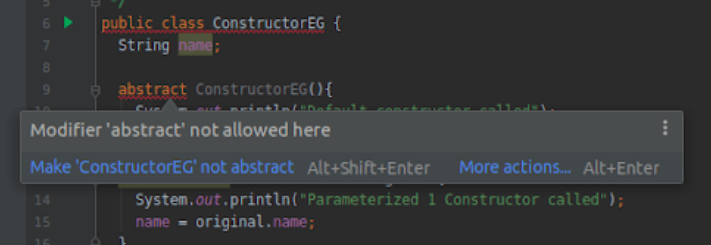
- A Java constructor cannot use the keywords abstract, static, final, and synchronized.
One should keep these in mind while creating constructors, as not complying with these rules will result in compilation errors. As an example, you can see the error when an abstract keyword is used with the constructor in fig 2.
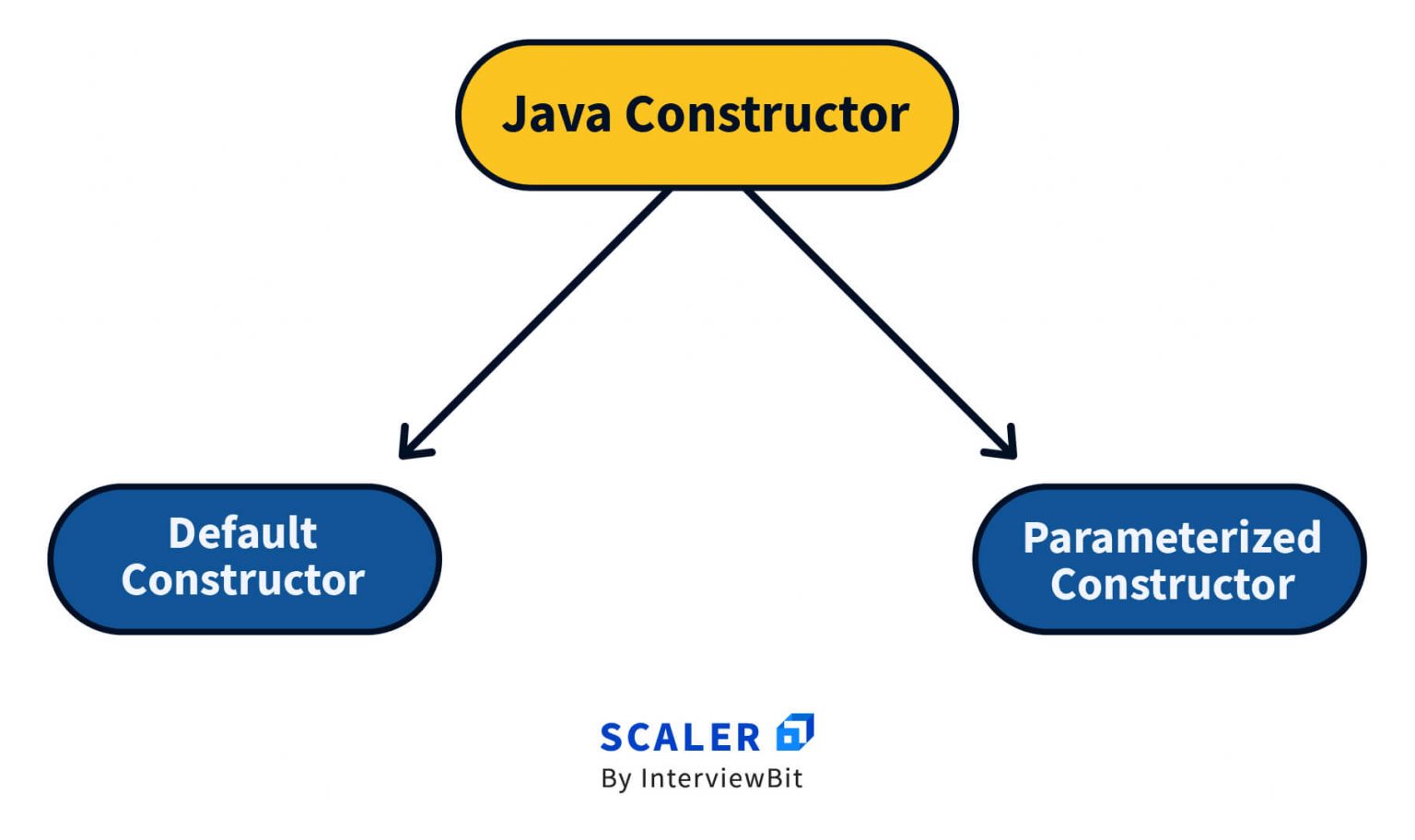
Types of Java Constructors
- Default constructor
- Parameterized constructor
Default Constructor in Java
This type of constructor is called whenever we create an object without passing any argument to the constructor.
Code Snippet 1:
public class ConstructorEG { String name; // default constructor ConstructorEG(){ name = "example" ; System.out.println( "Constructor called" ); } public static void main (String[] args) { ConstructorEG object = new ConstructorEG(); System.out.println(object.name); } }
Output
Constructor called example
Here in Code Snippet 1 we can see when we create an object with the new keyword the default constructor is called. This default constructor sets the value of the name variable. Default constructors are majorly used to initialize the member variables of an object with some default values
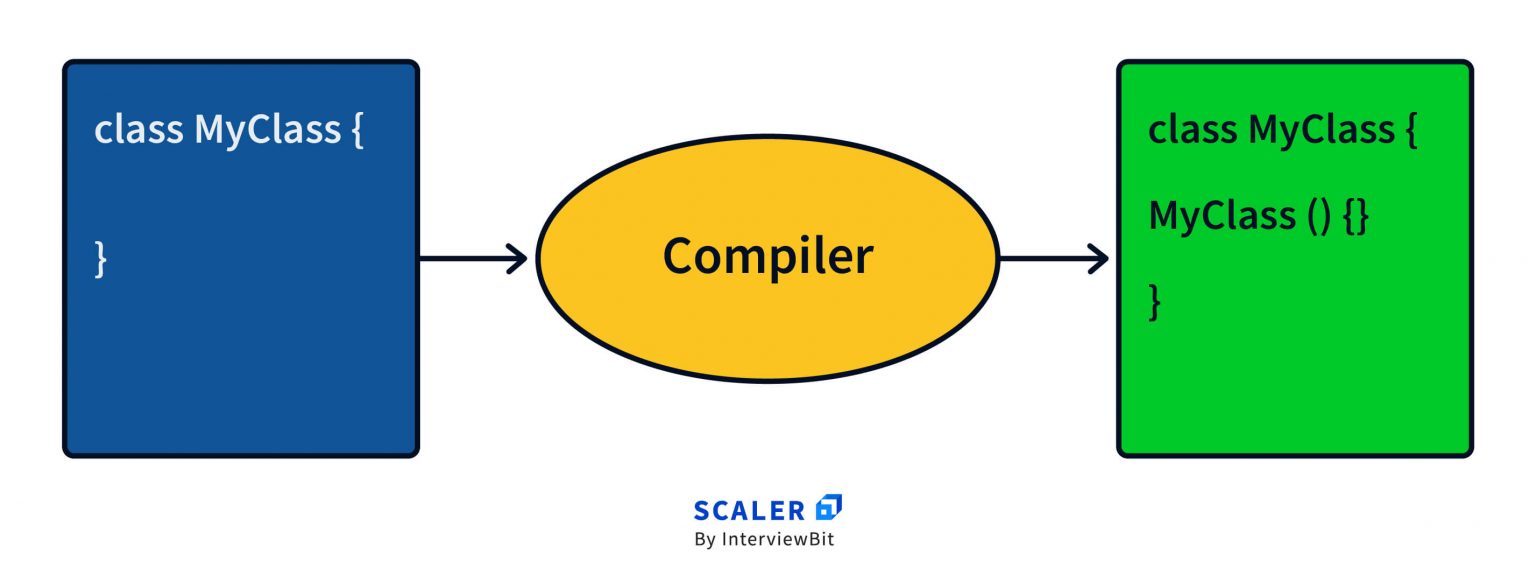
This constructor is automatically defined if we don't define any constructor. The compiler automatically generates a default constructor to all classes while compiling. But, if someone defines anyone constructor the compiler will not generate any constructor. So, in case someone defines a parameterized constructor and tries to define an object by MyClass myObject = new MyClass();, it will generate a compilation error because it is trying to call the default constructor which is unavailable. So in this case the user needs to define both the constructors.
Parameterized Constructor in Java
This type of constructor is called if we want to initialize an object by passing a few arguments in the constructor. In this, we initialize some members of the object by passing some parameters as an argument while initializing an object of the class.
Code Snippet 2:
public class ConstructorEG { String name; // parameterized constructor ConstructorEG(String defaultValue){ System.out.println( "Constructor called" ); name = defaultValue; } public static void main (String[] args) { ConstructorEG object = new ConstructorEG( "custom value" ); System.out.println(object.name); } }
Output:
Constructor called custom value
Here we can see, while creating an object with the new keyword, we passed a String , this value is then set to the data member of the class i.e. name.
Constructor Overloading in Java
Till now we know how different Java constructors work. We know that constructors are similar to methods but they don't have return types. Also, we can pass arguments while calling both. If we look closely all the constructors are of the same name, but the only difference is the argument part. Doesn't it look like the constructors are being overloaded? Yes, it is. Since both, the constructor has the same name but different arguments, they show compile-time polymorphism i.e. overloading. Not only this, we can even overload parameterized constructors based on the number and type of arguments as can be seen in code snippet 3, the parameterized constructor 1 and 2 are overloaded. Let's check an example
Code Snippet 3:
public class ConstructorEG { String name; Integer number; ConstructorEG(){ // default constructor System.out.println( "Default Constructor called" ); } ConstructorEG(String defaultValue){ // parameterised constructor 1 System.out.println( "Parameterized Constructor for name called" ); name = defaultValue; } ConstructorEG(Integer number){ // parameterised constructor 2 System.out.println( "Parameterized Constructor for number called" ); this .number = number; } public static void main (String[] args) { ConstructorEG object = new ConstructorEG( "custom value" ); System.out.println(object.name); ConstructorEG object2 = new ConstructorEG( 123 ); System.out.println(object2.number); } }
Output:
Parameterized Constructor for name called custom value Parameterized Constructor for number called 123
Here in this example, we can see both types of the constructor are defined in the same program and Since we are passing arguments while creating the object, the parameterized constructor is called. There are times when the default constructor needs to be called from a parameterized constructor, then this() is used. We can call the default constructor from the parameterized constructor using this() method.
Note: In case someone wants to call the default constructor, then, this() should be the first statement in the block else, the compiler will throw a compilation error.
Code Snippet 4:
public class ConstructorEG { String name; Integer number; ConstructorEG(String defaultValue){ this (); System.out.println( "Parameterized Constructor for name called" ); name = defaultValue; } ConstructorEG(Integer number){ System.out.println( "Parameterized Constructor for number called" ); this .number = number; } ConstructorEG(){ System.out.println( "Default Constructor called" ); } public static void main (String[] args) { ConstructorEG object = new ConstructorEG( "custom value" ); System.out.println(object.name); ConstructorEG object2 = new ConstructorEG( 123 ); System.out.println(object2.number); } }
Output:
Default Constructor called Parameterized Constructor for name called custom value Parameterized Constructor for number called 123
Here we can see, we called the parameterized constructor, but, since we called the default constructor using this() from the first line of the parameterized constructor, the default constructor execution completes first.
Difference between constructor and method overloading in Java
- Constructor is used to initialize an object whereas a method is used to perform certain functions of a class.
- Constructors are invoked implicitly when an object is created whereas methods are called explicitly by the user.
- Constructors don't have a return type whereas methods have a return type of either a type of Object or void.
- Constructor should have the same name as that of the class whereas method name should not be of the same name as that of class.
Copy Constructor in Java
Copy constructors help in initializing an object by copying data value from another object of the same class. You can consider it like cloning an existing object to create a new copy. Unlike C++, Java doesn't have default support for copy constructors, but we can implement a copy constructor of our own using a parameterized constructor. Here is how we will do this
Code Snippet 4:
public class ConstructorEG { String name; ConstructorEG(ConstructorEG original){ System.out.println( "Parameterized 1 Constructor called (COPY CONSTRUCTOR) " ); name = original.name; } ConstructorEG(String name){ System.out.println( "Parameterized 2 Constructor called" ); this .name = name; } public static void main (String[] args) { ConstructorEG object = new ConstructorEG( "custom value" ); System.out.println( "Original object - " + object.name); ConstructorEG newObject = new ConstructorEG(object); System.out.println( "Copied object - " + newObject.name); } }
Output:
Parameterized 2 Constructor called Original object - custom value Parameterized 1 Constructor called Copied object - custom value
We can see in this example, we create an object with a name as a custom value. Then we passed this object as an argument to the copy constructor (implemented through a parameterized constructor). When we print the value of the name in the newly copied object, we can see that the name is also copied to the new object newObject.
Copying values without constructor
By this time we know how copy constructors work. But, we can clone an object in Java without using a copy constructor too. In other words, we can copy the values of one object to another without the use of a copy constructor. Since we have to implement our own logic in the copy constructor we can see that this logic need not necessarily be placed in a constructor. We can place the code logic anywhere we need. Let's do this with an example.
Code snippet 5:
public class ConstructorEG { String name; ConstructorEG(){ } ConstructorEG(String name){ this .name = name; } public static void main (String[] args) { ConstructorEG object = new ConstructorEG( "custom value" ); System.out.println( "Original object - " + object.name); ConstructorEG newObject = new ConstructorEG(); newObject.name = object.name; //line number 22 System.out.println( "Copied object - " + newObject.name); } }
Output:
Original object - custom value Copied object - custom value
Here in the code snippet 5 , we can see in line number 22, we have explicitly copied the value of the name in the newly created object newObject. This is how we can copy values without the use of a copy constructor.
Conclusion
In this article, we saw how we can define and overload constructors in Java. Java doesn't support copy constructor by default but we can implement it by using a parameterized constructor. Here are some of the use cases where to use which constructor.
Usage:
- The default constructor is used to initialize the default values of data members of the class.
- The parameterized constructors can be used to create a copy of an object.
- Parameterized constructors are also used to set member variables of an object while initializing. :::
Source: https://www.scaler.com/topics/constructor-overloading-in-java/
0 Response to "Constructor Overloading in Java Simple Example"
Post a Comment