Run the Simulation Again. What Is the Value of Tb_alu_result for This Instruction?

If you lot need to fill-in your system, in that location is no better mode than making a fill-in with rsync.
Rsync (Remote Sync) is a pop and powerful tool used to copy and synchronize files and directories between remote or local Linux/Unix systems. With the help of rsync, nosotros can easily re-create/synchronize information betwixt local and remote directories, across unlike drives and networks.
In this tutorial, I will evidence you lot how to make a fill-in with rsync using the Linux concluding. If you prefer graphical programs, you tin can use rsync with graphical interface too.
Video Tutorial
Making the fill-in with rsync
To brand this tutorial, I volition use Curvation Linux in a virtual machine built with VirtualBox. To simulate an external difficult drive, I will connect a USB flash drive where the backup volition be stored and so restored. I recommend you do the aforementioned to test your backup. This volition requite you the confidence to know that your fill-in works because an untested fill-in is not a backup.
For this instance nosotros will use this unabridged command:
sudo rsync -aAXv --delete --dry-run --exclude=/dev/* --exclude=/proc/* --exclude=/sys/* --exclude=/tmp/* --exclude=/run/* --exclude=/mnt/* --exclude=/media/* --exclude="swapfile" --exclude="lost+institute" --exclude=".cache" --exclude="Downloads" --exclude=".VirtualBoxVMs"--exclude=".ecryptfs" / /run/media/alu/ALU/ To make a backup with rsync, we usually use the command line. I know that not everyone is confident with the control line tools, only yous will realize that the process is not that complicated and yous can likewise back up your system using the command line.
We now proceed to explain what this control means:
sudo - to execute the command every bit a superuser. Mandatory utilise.
rsync - is the program itself to use.
-a - archive mode.
-A - preserve Admission Control List.
-X - preserve extended attributes.
Basically, these three options hateful to preserve all the attributes of your files. Owner attributes or permissions volition not be modified during the backup procedure.
-v - It volition evidence the progress of the backup.
--delete - this option allows y'all to make an incremental backup. That ways, if information technology is not your first backup, it will backup only the divergence between your source and the destination. And then, information technology will backup only new files and modified files and it will also delete all the files in the backup which were deleted on your system. Be careful with this option.
--dry-run - This selection simulates the backup. Useful to test its execution.
--exclude - Excludes folders and files from backup. I typed exclude every bit a carve up selection for every directory. You can also employ information technology this way --exclude={/dev/*,/proc/*,/sys/*,/tmp/*,/run/*,/mnt/*,/media/*,/domicile/*,/lost+found}. But brand sure you change your working directory to root (cd /) before you run rsync, otherwise the joint exclude option may not piece of work.
The excluded folders depend directly on each of united states, all the same, the /dev/, /proc/, /proc/ /sys/ /tmp/ /run/ /mnt/ and /media folders are not important to backup because rsyn will non re-create their content. /mnt/ it is vital to exclude them if we connect a USB memory.
/ - What nosotros want to support.
/run/media/alu/ALU - This is where you lot what to fill-in. I recommend to enrypt the destination, to make your information prophylactic.
Nosotros press enter, the control will execute in a simulation mode (because of the --dry-run selection) This manner nosotros test it to make certain everything is okay. When y'all're sure that everything is performed every bit you lot desire, you remove --dry-run from the command and run information technology over again.
Note: It is recommended that the backup bulldoze has a Linux compatible file system every bit ext4.
Restore the fill-in with rsync
To restore the backup we have made, nosotros are going to kick from a live ISO. Since we are working with Arch Linux, then the iso epitome must exist from Arch Linux. Side by side, we must mount our USB wink drive.
Once logged in from the live epitome, we must create two folders, one for the system on the hd and the other where the fill-in created volition be mounted:
mkdir /mnt/organisation /mnt/usb Next, we need to check the names of our devices:
Then, we must mount the file system and the backup on the USB flash device:
mount /dev/sda1 /mnt/arrangement mountain /dev/sdb1 /mnt/usb 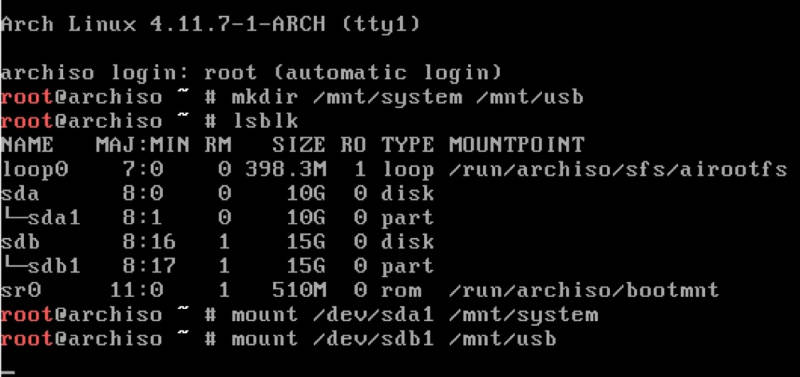
Finally, nosotros proceed to perform the restoration of our fill-in. For this we run:
rsync -aAXv --delete --exclude="lost+found" /mnt/usb/ /mnt/system/ By running this command, we restore the backup of our organisation.
Decision
Rsync is a powerful tool that can be used from the command line, with multiple options that conform to any need. You lot can of course utilize fill-in programs with graphical interface. There are also some really practiced non-open sources graphical backup programs.
To brand your backup safe, I also recommend encrypting your fill-in drive.
Have you lot already washed your backup? Let me know nigh your experience with rsync.
Please share this article through your social networks.
Source: https://averagelinuxuser.com/backup-and-restore-your-linux-system-with-rsync/
0 Response to "Run the Simulation Again. What Is the Value of Tb_alu_result for This Instruction?"
Post a Comment